Fixing legacy UX issues and improving flow consistency in Block Jam 3D – Voodoo
2024 - research, UX, UI, testing
I contributed to the ongoing development of Block Jam 3D, a hybrid casual mobile puzzle game with 10M+ downloads. Our team received the game when it was already on the market and had established mechanics, I addressed legacy UX issues to improve user engagement and increase sales numbers on existing features. I also did market and user research, collaborated closely with game designers, developers, monetisation managers and artists to ensure a smooth player experience.
Season Pass rework (UX - UI)
A simple UI update was planned at first, but deeper issues surfaced during research, and we saw the opportunity to improve monetisation value of this feature. The main goal shifted to UX fixes.
Workflow: I started with mechanics breakdown, and it became clear, that existing layout and explanation text are not straightforward enough. The biggest issue was the vague value of the Block pass and the mechanics of the Bonus bank. And if players don’t understand how it works and if it’s even worth it - they don’t buy block pass.
While working on this, I also researched competitor games and how they handle similar feature (main benchmark being Toon Blast and Royal Match - few of the most successful hybrid casual games on the market at the time)
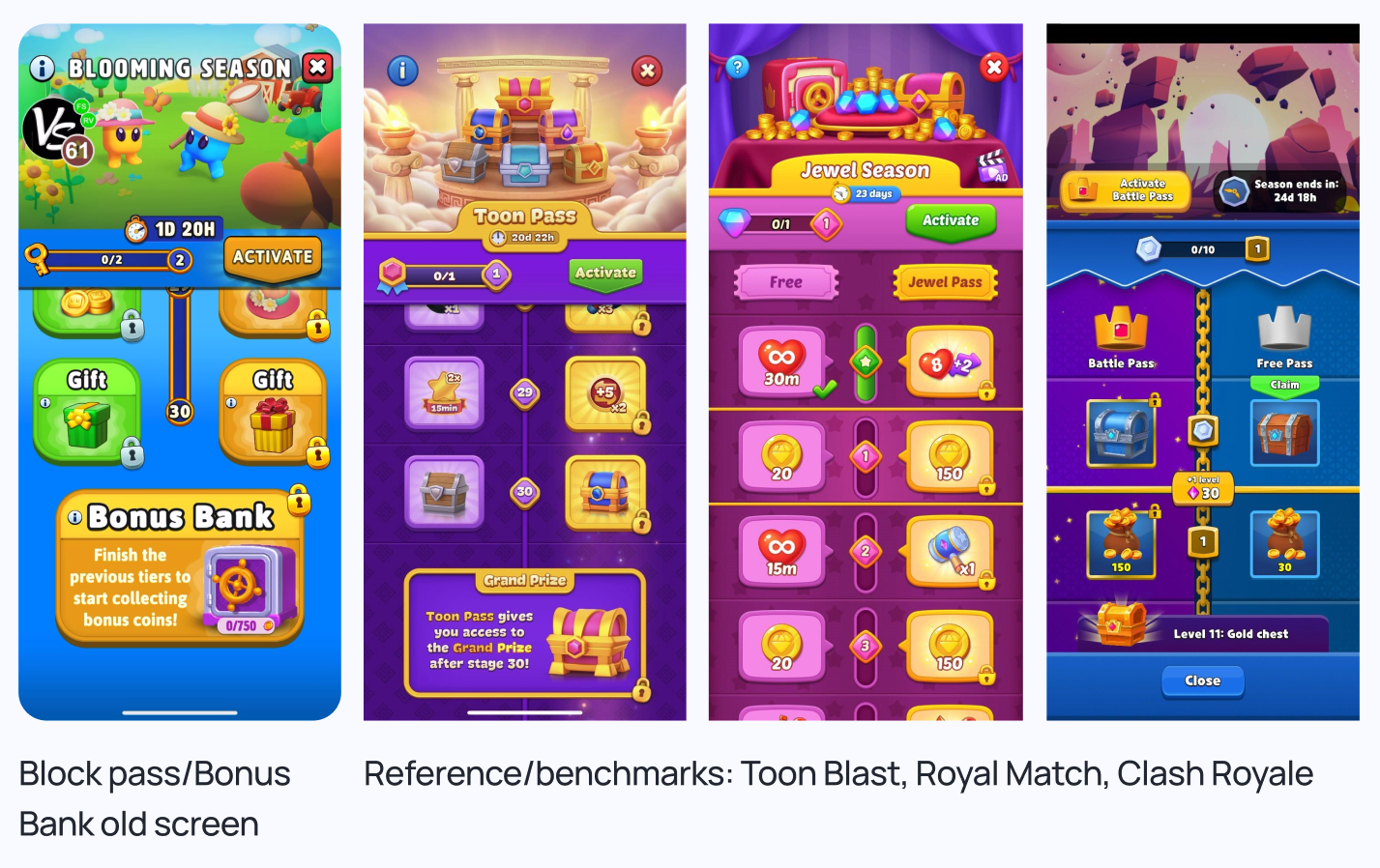
Layout changes for clear flow
During the breakdown of the feature's mechanics, I identified UX issues that impacted clarity and engagement.
One example was the "bonus bank" element: its unlock flow was unclear, and its purpose wasn’t easily understood by players. I redesigned the widget, progress bar, added a simple unlocking animation, and improved the instructional popup to better communicate its function. With better flow, explaining how the feature works, it started to feel more valuable and made the attractiveness of the whole golden season pass purchase higher.
While the main goal now was to fix UX issues, The game was still going through the major visual update.
New UI style
New art-style was set up by the art director. He created several examples for UI elements like title badges, rewards, and pop up styles, new font. I was requested to be very close to Royal Match example and used it as a main benchmark. While I personally prefer a more minimalistic style, not overloaded with details and shadows, market research shows that this level of detailization is the norm in casual games and most popular titles use similar approach (from Candy Crush to Royal Match). And players would rather go for familiar visuals. This approach was also confirmed by the previous title that the same art director worked in this studio, so it was a safe way to go.
While updating the visuals, I worked closely with the lead artist and developer to address technical limitations - our newer, more complex UI style revealed technical setup problems that prevented a simple asset swap. We cleaned up the project and implemented a few new setups and templates.
Checking for contrast and color blindness types as a part of the UI process - new version highlights premium pass more, than the basic one, which is how it’s supposed to be. Rewards stay highlighted in the basic one still. Name of the event is also better visible.
Season end screen
Season ending screen looked incomplete and didn’t convey information in a clear way. There was:
- no full description of what happens with bonuses or if there will be a new season
- no reminder for which season was this one…
I redesigned it to match the game's new visual tone and clearly communicate key information, this screen also became a template for other event-like features, so that the info is presented in the same way across the game. 3D Artist created Illustrations.
new flow:
- showing name of the season
- adding better explanation of the rewards
- adding a timer as a visual queue to the duration of the event (another screen needed to be created to announce the upcoming event and I used similar layout)
- unclaimed rewards collected within the feature flow, now using the same separate layout as reward collection in all other features.
FTUE - making sure players know about new events (UX)
We had a problem with some events not being played enough, even though the overall user base grew. There were a few cross-department brainstorming sessions and it was decided to look into how events are being introduced.
At the time, some flows were forced click through-s and some events just started on top of each other, showing players multiple pop ups, which could be annoying for the users.
We worked on a new FTUE flow for the Season Pass feature, to later use it as a template for other features across the game.
Problem: in a game with multiple side quests (in addition to main gameplay) players are sometimes overwhelmed and don’t notice all the features we gradually introduce. To improve participation rate, we need to find a way to direct player’s attention to said feature and make sure they don’t skip it.
Research: it’s a complex problem, that needs to be looked at from all perspectives/per feature (Is internal economy balance broken? Are there bugs? Are the visuals outdated?). But one part of the problem - players missing events’ introduction because of information overload - can be fixed.
Solution: New FTUE should
- introduce new features coherently and can’t be interrupted by other things (other events, rewards, level ups..)
- be forced - players have to click through the feature tutorial, otherwise it can be just another notification that they ignore
- a flow that works across all features
- be recognisable - players should be familiar with something similar from other games (hand icon tapping is often used)
- be only one per level - no starting 2 new events at once on level 5, for example
- separate approach for players, who already progressed beyond level 20 but haven’t participated in the event yet - they also get a forced click through tutorial, we need to set a few levels where it can be triggered (levels, that have no other events)
After several iterations and internal testing (playtests with team members, not actively working on this feature to minimise bias), we rolled out the update.
Even though we didn’t have the time and resources to A/B test new UI and new flow separately, rolling out this big update increased active users numbers and block pass sales, so it was considered an overall success.